
Suwannee Parole and Probation
Parole and probation can both follow a criminal case, but they begin in different ways. Parole is a conditional release from a prison sentence under the authority of the Florida Commission on Offender Review. Florida parole now applies mainly to older or narrowly defined cases because eligibility turns on the offense date, conviction, and sentence. Probation is a court-ordered term served in the community instead of, or after, confinement. The Florida Department of Corrections operates state community supervision, while the Commission makes parole and several other release-review decisions.
A Suwannee County Jail booking card cannot settle this question. It can show that a local booking ended, yet it does not prove parole eligibility, identify every probation order, or show compliance. The sheriff also does not decide state parole. For a state-prison case, use the FDC release and supervision databases together. For an order entered in a Suwannee case, obtain the judgment, sentence, and probation terms from the Clerk because local court case files are not posted online.
| Point | Parole | Probation |
|---|---|---|
| How it begins | Conditional release from an eligible prison sentence through FCOR action | A sentence or order entered by the court |
| Public status source | FDC Supervised Population plus the written FCOR action | FDC Supervised Population for state supervision; Clerk order for county probation |
| Main local record | Release detail, supervision detail, and Commission order | Judgment, probation order, and supervision detail when FDC covers it |
| How it ends | Expiration or a lawful FCOR discharge or modification | Termination shown by the controlling order and supervision record |
- Parole
- Conditional freedom from an eligible prison sentence under Commission rules.
- Probation
- Court-ordered supervision served in the community.
- Discharge
- The formal end of a supervision term, distinct from release from prison.
- Absconder
- An FDC status meaning the person is unavailable to supervision and a violation warrant has issued.
Verify Suwannee Post-Release Supervision
The FDC Supervised Population Information Search is the main public source for state probation, parole, conditional release, and other FDC supervision. It accepts first and last name, the six-character DC number, alias searching, and photo controls. A detail can show the DC number, identity, supervision begin date, current location, current status, supervision type, scheduled termination date, aliases, offenses, and present or prior community-supervision history. FDC says the database receives a full refresh weekly, while termination dates and location changes update nightly.
The search expressly excludes people sentenced only to county jail, county probation, or another form outside FDC. That limit matters in Suwannee County. If the state search returns nothing, do not treat the absence as proof that no probation order exists. The Suwannee Clerk FAQ directs requests for the actual order to the Clerk, whose case files are not online. Call the criminal division and identify the case number from the jail record when possible.
- Search FDC Inmate Release Information first when state prison is involved. Confirm identity, DC number, a past release date, and the final out-of-custody entry.
- Reuse that DC number in Supervised Population. Name-only matches need comparison against birth date, photo, offense, and county information.
- Read the exact supervision type and current status. Do not call every state-supervised person a parolee.
- Open the linked current location. That field identifies the office attached to the live record and is stronger than an assumed county assignment.
- Obtain the judgment, probation order, or written FCOR action when the legal terms, conditions, or ending date matter.
The successful search screenshot in the manifest shows the actual state fields and the county-probation exclusion. View the source at the official FDC supervision search.
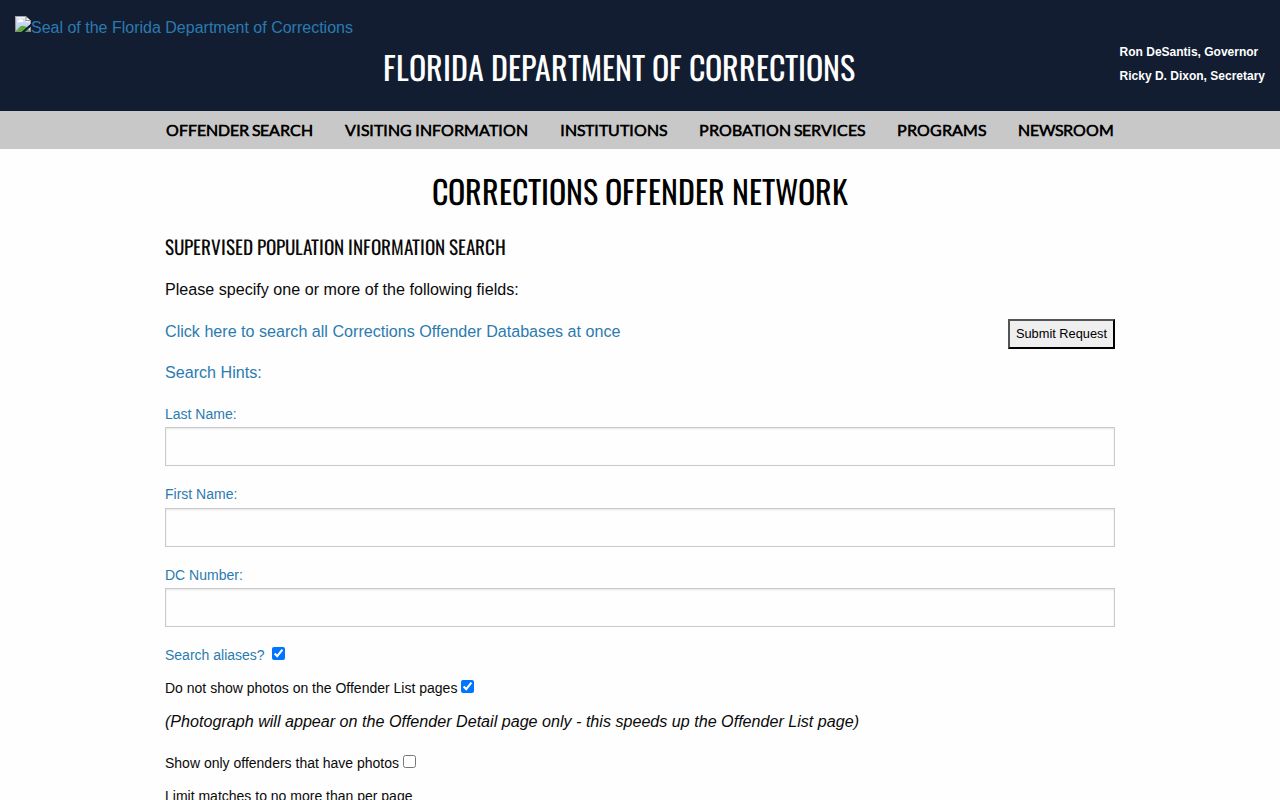
Those search controls lead to state supervision summaries, not Suwannee County jail releases or county-only probation files.
A released jail record and an active supervision record answer different questions, so verify both custody release and the later legal status.
Suwannee Supervision at Live Oak
FDC's Lake City Circuit Office page identifies the local unit as 031 - LIVE OAK. The circuit covers Suwannee along with Columbia, Dixie, Hamilton, Lafayette, Madison, and Taylor Counties. The live person's supervision detail still controls because assignments can change. A person should follow the assigned officer's directions rather than relying on an old office listing or a pre-reporting form.
FDC 031 - LIVE OAK506 Houston Avenue NW
Live Oak, FL 32064
Phone: 386-362-2869
Fax: 386-364-4936
For statewide public-search questions, FDC lists Probation and Parole Field Services at 850-717-3444 and co-supervision@fdc.myflorida.com. The Lake City circuit administrative office is at 1435 US Highway 90 W, Suite 120, Lake City, with phone 386-362-2878. These contacts can help route an inquiry, but they do not replace the supervising officer or the written court or Commission order.
The manifest image documents the office listing. The source is the official FDC circuit directory.
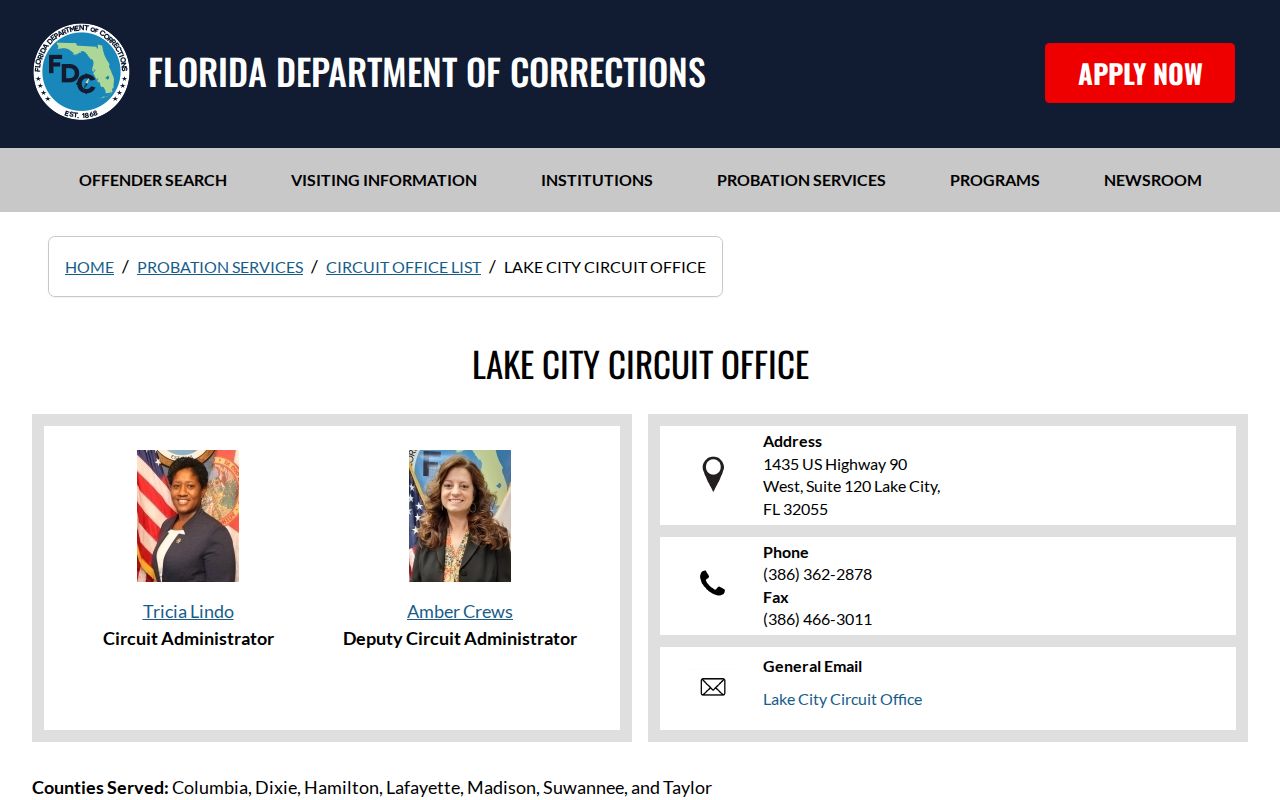
The listing confirms a local service point while the linked current-location field remains the best person-specific office check.
Note: Office listings route contact, but a current supervision detail and assigned officer provide the person-specific reporting instructions.
Suwannee Release Support Through FDC
The Live Oak community-corrections listing provides a local reentry layer beyond a name and status search. It identifies purpose-neutral supports such as Life Skills, supervision and community-control orientation, Thinking for a Change, Moral Recognition Therapy, and counseling referrals. These services sit within state supervision. They do not mean every person has the same condition, treatment plan, or referral. The controlling plan comes from the court or Commission order and the assigned officer's instructions.
Community control is a more restrictive form of supervision than ordinary probation and may involve close monitoring. Orientation helps explain reporting duties, while the listed courses and referrals can address the needs identified in a person's supervision plan. A released person whose record points to another office should use that location instead of reporting to Live Oak based only on residence or the county where the case began.
This local office detail is most useful after identity and status are confirmed. The Suwannee County released-inmate search path explains how the jail timestamp, FDC release record, and court file fit together before the supervision check.
Suwannee Supervision Status Terms
Conditions vary by the controlling order. At a high level, supervision can require reporting, compliance with lawful instructions, and completion of terms set by the court or Commission. Public database summaries do not display every duty. They also can change. Read the original order when the exact scope matters, and use the FDC detail to confirm current type, status, location, begin date, and scheduled termination date.
FDC defines ACTIVE as active community supervision. ACTIVE SUSPENSE can mean the person is temporarily unavailable for direct supervision because the person is in jail or another facility while FDC monitors the case. It is not proof that the person is currently present in the community. A scheduled termination date is also not the same as a completed discharge. Later court or Commission action can alter the term.
Florida VINE can provide custody-change alerts for a specific person, but it is not the controlling supervision record. For a state case, compare the alert to FDC. For a Suwannee County Jail event, compare it to SmartWEB and the sheriff's release record. A transfer can end one facility's booking while custody continues elsewhere.
Suwannee Absconders and Warrants
An absconder result is a later supervision event, not a new release type. FDC defines ABSCONDER as a person whose whereabouts are unknown or unavailable to supervision and for whom a violation warrant has issued. The separate Absconder/Fugitive Information Search should be used instead of trying to infer the status from a jail card. FDC says that search refreshes weekly, with termination and location changes updated nightly.
The Suwannee Sheriff warrants page describes violation-of-probation, community-control violation, capias, bond revocation, and other warrant types, but it does not supply a searchable named local list. A warrant alone does not prove a new jail release, parole, or a current location. Information about an FDC absconder can be sent to the FDC Absconder Unit at 850-717-3475 on weekdays from 8:00 a.m. to 5:00 p.m., or to local law enforcement. Do not approach a person based on a public result.
The successful manifest capture shows the dedicated form. Its source is the official FDC absconder search.
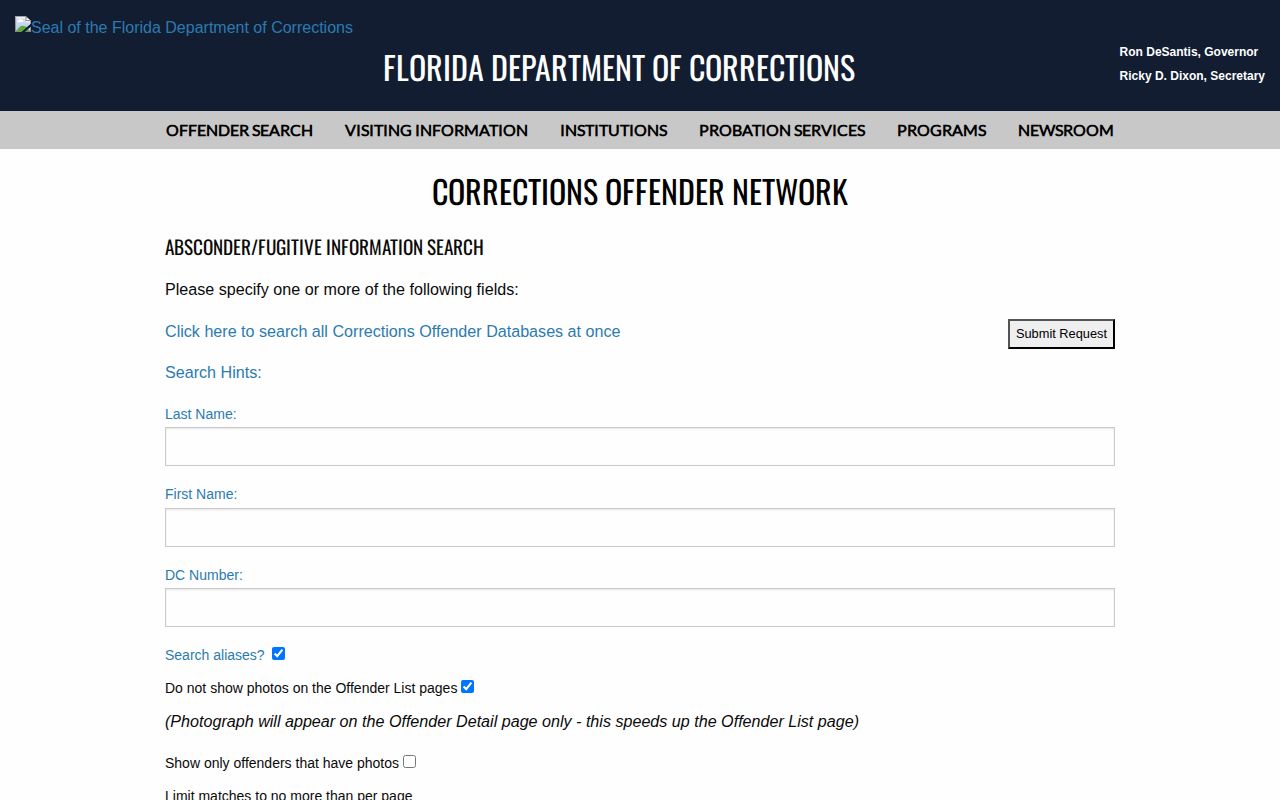
The separate form helps keep release confirmation, ordinary supervision, and warrant status from being collapsed into one claim.
An absconder or warrant result calls for agency confirmation and safe distance, not personal contact or an assumption about present location.
Suwannee Parole Decisions and Records
FCOR, not the sheriff, makes Florida parole and several related review decisions. Its Commission Voting Schedule is a rolling calendar that can list meeting dates and links to detailed parole-case agendas. Agenda fields may include a name, DC number, category, county, offense, and case number. That tells what is scheduled. It does not show what the Commission decided, so an agenda entry cannot support a claim that parole was granted, denied, delayed, or completed.
For the outcome, request the written Commission action or order through the FCOR public-records route. Identify the person, DC number, and hearing date. Depending on the issue, ask for the presumptive parole release date action, effective parole release date action, release order, or supervision-discharge order. FCOR lists fcorlegal@fcor.state.fl.us, 850-848-4460, and the Office of Commission Clerk at 850-488-1293. It says a request need not be written and may be anonymous.
Parole eligibility is largely legacy-based in Florida. FCOR explains that sentencing guidelines effectively ended parole for most crimes committed on or after October 1, 1983, subject to defined exceptions. Eligibility depends on the offense date, conviction, sentence, and statutory category. A future FDC Current Release Date is therefore not proof that FCOR will act or that a person qualifies for parole.
Note: A hearing calendar proves scheduling only; the written FCOR action supplies the decision, terms, and any later discharge language.
Suwannee Supervision Discharge Records
Release from prison and discharge from supervision are separate events. The FDC release detail can establish a past prison release, while Supervised Population may show that parole, probation, conditional release, or another term continued afterward. The displayed scheduled termination date is useful, but final verification comes from the updated status and the controlling court or Commission record.
For probation, obtain any termination, modification, violation, or revocation order from the Suwannee Clerk. The Clerk's case files are not online, so use the criminal division and the court case number. For parole or another FCOR-controlled term, request the written Commission action. Section 947.24 allows FCOR, on statutory findings, to modify terms, relieve reporting, or discharge supervision. That is why a prison release date cannot be reused as a supervision end date.
A complete verification chain preserves each step: the custody release, the supervision type and begin date, any status change, and the final discharge or termination. This avoids treating an old active entry, a future scheduled date, or a jail booking end as the whole record.